
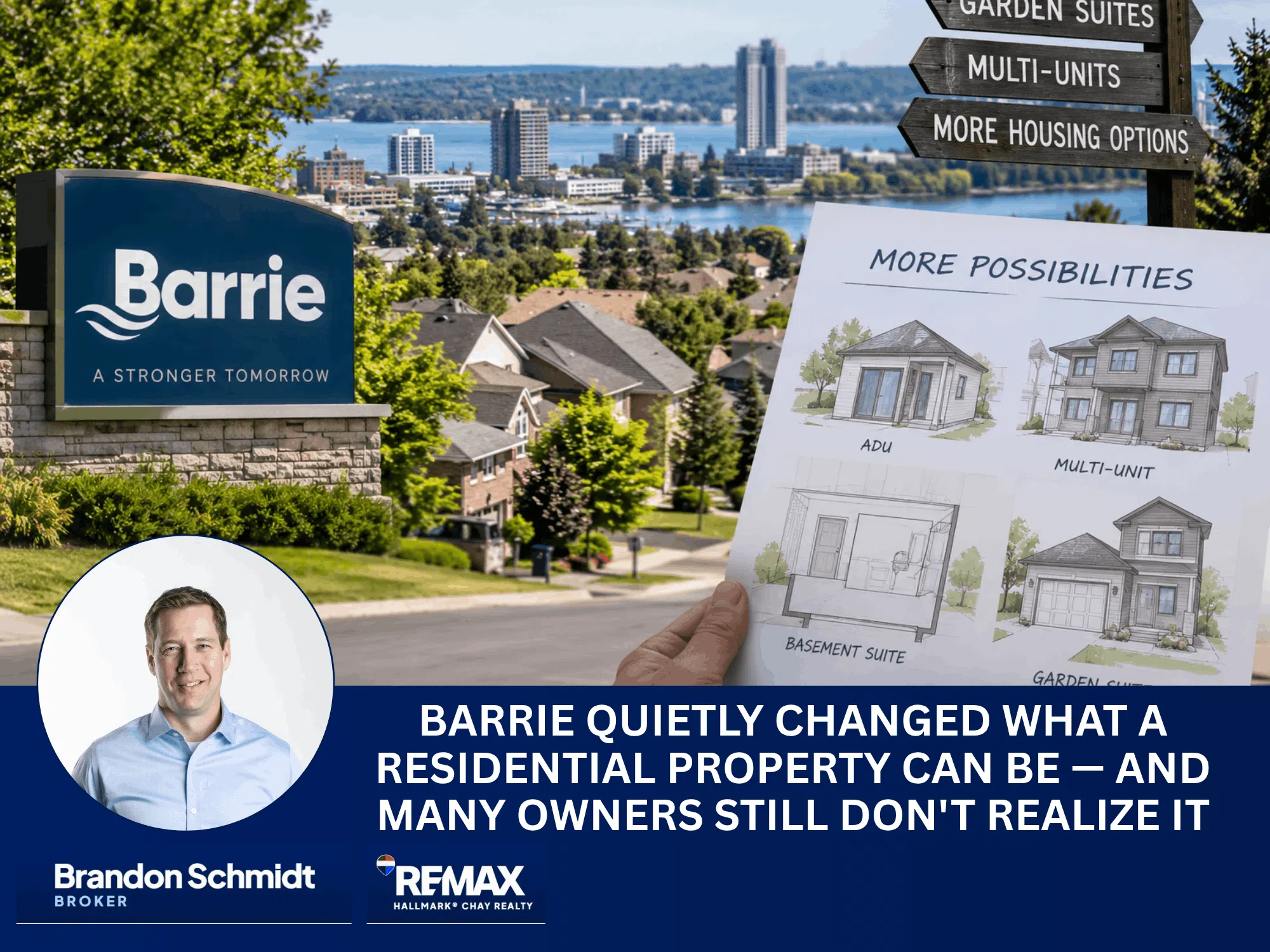
Barrie Quietly Changed What a Residential Property Can Be — And Many Owners Still Don’t Realize It
When people talk about the future of housing in Barrie, the conversation usually turns to something large and visible: new subdivisions in the south end, condominium towers downtown, construction cranes or another proposed apartment building along one of the city’s major roads.
One of the more significant changes to Barrie’s housing market, however, may be happening much more quietly. It is happening on ordinary residential streets and, in many cases, on properties that have already been there for decades.
In April 2024, Barrie changed its zoning rules to permit as many as four residential units on qualifying residentially zoned properties. Under the current zoning by-law, a property with a single detached home, semi-detached home or street townhouse can potentially contain up to three additional residential units, for a maximum of four residential units on the lot. Those units may potentially be located within the main house or, where the requirements can be met, within an accessory building or structure.
That does not mean every house in Barrie can suddenly become a fourplex. There are still zoning standards, building permits, parking, servicing, access, grading, conservation restrictions and Ontario Building Code requirements to consider.
But the change is significant because it alters a question buyers and owners may increasingly ask about residential real estate.
Instead of simply asking “What is this house?”, we may also have to start asking “What could this property legally become?”
A House May No Longer Just Be a House
Consider a fairly ordinary Barrie detached home: three bedrooms upstairs, an unfinished basement, a driveway and perhaps a detached garage sitting toward the back of the lot.
Traditionally, most buyers would evaluate that property primarily as a single-family house. They would compare the kitchen, bedrooms, bathrooms, lot size, garage, renovations and neighbourhood with competing properties.
Those things still matter enormously.
But Barrie additional residential units introduce another layer of potential value. Could the basement accommodate a proper second suite? Is there enough parking? Could an addition create another self-contained unit? Could an existing accessory building eventually be converted or replaced with a detached unit? Depending on the lot and zoning compliance, could the property ultimately accommodate more than two households?
The City identifies basement apartments, in-law suites, coach houses, secondary dwellings and additions to existing homes as common examples of ARUs. It also notes that they can provide housing for family members, support aging in place and generate rental income.
The important word, however, is potentially.
Two houses that look almost identical from the street may have very different possibilities once parking, lot coverage, setbacks, servicing, access and the existing layout are considered.
That means the future usefulness of a property may increasingly become another part of how sophisticated buyers compare homes.
Barrie Is Offering Owners a Reason to Look at This in 2026
The timing is particularly interesting because the City isn’t merely allowing more units. It is actively trying to encourage owners to build them.
For qualifying Barrie additional residential units applied for in 2026, the City is reducing eligible building-permit application fees by 50%. Owners who complete the project and achieve occupancy, or the equivalent final interior inspection, within 12 months of permit issuance may qualify for a rebate of the remaining eligible building-permit application fees.
The program applies to new ARUs created through interior conversions, additions and qualifying detached units, and even to certain new construction containing two to four units. Applications must be made during 2026, funding is limited, and various other expenses such as development charges and unrelated renovation costs are not included in the rebate.
There may be considerably more assistance available where the new unit meets affordable-housing requirements.
The County of Simcoe’s Secondary Suites Program currently offers eligible applicants funding of up to $50,000 per unit for the creation of qualifying affordable ARUs. A Barrie homeowner approved for that County funding may also qualify for the City’s $15,000 Barrie Bonus top-up. Funding is limited, eligibility requirements apply and an owner should understand the affordability conditions before assuming either program will work for a particular project.
The point is not that every homeowner has $65,000 waiting for them.
The more interesting point is that different levels of government are putting actual money behind the idea of creating more housing on properties that already exist.
Why Is Barrie Encouraging This?
The simple answer is growth.
Barrie’s estimated population reached 167,176 in 2025. The City’s growth projections anticipate approximately 210,000 residents by 2031, 253,000 by 2041 and 298,000 by 2051. If that projection is reached, Barrie will add roughly 131,000 residents from its 2025 population over the next quarter century.
The City is already building. Barrie reports 4,239 dwelling units started between January 1, 2023 and February 28, 2026.
But it is difficult to imagine all of Barrie’s future housing being accommodated by simply extending subdivisions farther outward. The City’s Official Plan specifically anticipates more compact development and greater intensification as Barrie moves toward a population of 298,000.
That makes Barrie additional residential units part of a much larger story.
Instead of replacing an entire neighbourhood with apartment towers, ARUs allow density to increase gradually—one basement apartment, coach house or additional dwelling at a time.
Over 20 or 30 years, that could substantially change how some established Barrie neighbourhoods function without dramatically changing how they look from the street.
Could ARU Potential Affect Property Values?
This is where I think the conversation becomes particularly interesting for real estate owners.
A property having the theoretical ability to accommodate another unit does not mean you can simply attach a dollar value to that possibility. A $100,000 construction project doesn’t automatically add $100,000 to the selling price, and a basement that looks suitable for an apartment isn’t automatically a legal rental unit.
The economics have to work.
Construction costs matter. So do achievable rents, financing, insurance, utilities, parking, privacy and how much of the main house needs to be altered.
But buyers may increasingly place a premium on optionality.
A wide driveway may matter for more than parking the family’s vehicles. A separate entrance may matter for more than bringing furniture into the basement. A detached garage may represent more than storage. A deeper lot or favourable layout may offer flexibility that the nearly identical house around the corner does not.
For some buyers, a legal rental unit can help offset ownership costs. For another family, it may provide a private place for an aging parent. Someone else may want space for an adult child without having them leave the property altogether.
The same physical space can solve very different problems.
That flexibility can have value.
“Existing” and “Legal” Are Not the Same Thing
There is one caution I would put above almost everything else when looking at Barrie additional residential units: never assume a unit is legal because it already exists.
A basement kitchen, bathroom and separate entrance do not prove that a legal second suite has been established. Neither does an old MLS listing describing a property as having an “in-law apartment” or “income potential.”
Barrie’s Second Suite Registration By-law requires second suites and detached accessory dwelling units to be registered with the City. A newly created second suite is automatically registered after it completes the required permit and inspection process. Older units created without proper approvals may require additional investigation and, in some cases, work before they can be legally recognized.
That distinction matters for both buyers and sellers.
A seller who can provide documentation showing that a unit was properly permitted, inspected and registered is offering something different from a seller who simply has a tenant living in the basement.
For a buyer, “potential” should be treated as something to investigate, not something to assume.
The Bigger Change May Be How We Think About a Property
Barrie’s housing market is going to evolve as the city grows toward 300,000 residents.
Some of that growth will be obvious: new subdivisions, larger apartment buildings and higher-density development.
Some may be almost invisible.
A basement becomes an apartment. A detached garage becomes a coach house. One household becomes two or three households occupying the same piece of land.
That is why I think the changes surrounding Barrie additional residential units are about more than rental housing.
They could gradually change the way people value ordinary residential property.
Bedrooms, bathrooms, renovations and location aren’t going anywhere. But buyers may increasingly add another question to the list:
What else could I legally do with this property?
For owners of the right property, the answer may be much more interesting today than it was only a few years ago.